Abstract
P4-SpecTec1 is a mechanization toolchain for the P4 programming language. It provides a domain-specific language for writing formal specifications in the form of algorithmic inference rules. In March 2026, P4-SpecTec was conditionally accepted by the P4 core team as the official language specification authoring toolchain for P4. However, P4-SpecTec currently lacks accessible learning resources: new users face a steep learning curve in understanding how to use the tool in practice.
This project addresses that gap with an end-to-end tutorial on utilizing P4-SpecTec. It guides readers through writing a complete mechanized specification from scratch, covering the toolchain basics, core semantic rules, debugging techniques, and prose generation. The subject of the tutorial is Nano-P4, an educational dialect of P4, whose mechanized specification is developed alongside the text and serves as its running example.
Beyond the tutorial itself, the project also improves how accessible P4-SpecTec
is to newcomers: a Nix flake provides a fully reproducible development
environment for contributors, and an opam package distributes the p4spectec
binary to users who want to install it without building from source.
Implementation Details
Nano-P4 Mechanized Specification
Relevant PRs:
The Nano-P4 specification lives in the
pacokwon/nano-p4-spec repository
as a collection of spec files, organized by phase and mirroring the structure of
the full P4 spec. The nano-p4spectec CLI that runs the spec is implemented in
p4spec/bin/nano.ml
in the
kaist-plrg/p4-spectec
repository (on the gsoc-nano-spec branch), where the spec is included as a
submodule.
Syntax and IR: The surface grammar of Nano-P4 is defined in
1-syntax.watsup as P4-SpecTec syntax definitions.
Static semantics: The static semantics defines what it means for a Nano-P4
program to be well-typed. The 5.xx-typing-*.watsup files define
type-checking relations for every syntactic category. The top-level Program_ok
relation orchestrates the full type-checking pass; if it succeeds, it produces a
typingContext capturing type definitions, as well as the types of identifiers
and callables.
Loading phase: The loading phase sits between type checking and evaluation.
While the typingContext records the type of each callable, it does not retain
the callable’s body; that information is discarded after type checking. The
loading phase (defined in 7.0-load-context.watsup and
7.1-load-declaration.watsup) walks the declarations a second time to build a
loadContext that pairs each callable with its body and records the entry-point
parser and control for the NanoSwitch architecture.
Dynamic semantics: The dynamic semantics defines what it means for a Nano-P4
program to run. The 8.xx-eval-*.watsup files define evaluation relations,
following the same structure as the static semantics. Each file covers a
syntactic category and contains inference rules that describe how they are
evaluated. The top-level NanoSwitch_sim relation models the NanoSwitch
architecture end to end: it runs the parser block on an input packet, then the
control block, and produces an output packet.
Test suite: The test suite has two kinds of test programs. Positive cases
are well-typed .p4 files that double as both static and dynamic tests. The
static test verifies that the Program_ok relation accepts the program. The
dynamic test executes the NanoSwitch_sim rule with an accompanying .stf
file. Negative cases are plain .p4 files that the type checker should reject;
no .stf is involved.
Tutorial
The tutorial is organized into seven chapters, starting from first principles to a working prose document:
P4-SpecTec: introduces the toolchain: installation, the core language constructs, the execution model, and the standard library.
Nano-P4: establishes what Nano-P4 is and what it covers: scope, syntax definitions written in P4-SpecTec, and the NanoSwitch architecture model.
Static Semantics: walks through the entire typing rules section by section: the typing context, type equality, expressions, l-values, statements, parameters, arguments, declarations, parser blocks, control blocks, and tables. Each section explains the design choices behind the rules. Exercises ask the reader to debug a broken spec, or fill in missing pieces in the spec.
Loading Phase: explains why a loading phase is necessary and walks through the load context and the declaration-loading rules.
Dynamic Semantics: mirrors the static semantics chapter in structure, covering evaluation context, values, expressions, statements, calls, calling convention, parser, control, and tables. Exercises similar to those in Chapter 3 can be found here.
Tips for Debugging: a practical chapter on how to debug a failing spec: reading error traces, inspecting values at each step, inserting
debugpremises to narrow down failures, and navigating the spec to find pattern-matching gaps. Includes two fully worked examples that walk from a failing run to a root cause and fix.Generating Prose Specification: demonstrates the prose backend: writing a skeleton AsciiDoc document with directive placeholders, running
nano-p4spectec spliceto fill them in from the spec, and compiling the result with Asciidoctor. Shows howprose_in,prose_out,prose_true, andprose_falsehints on relation definitions control the quality of the generated English.
Toolchain Availability
Relevant PRs:
Nix flake: A
flake.nix was
added to kaist-plrg/p4-spectec, pinning all build and runtime dependencies.
Running nix develop drops into a shell with OCaml, opam, and every required
library already present. This gives contributors the option to create a fully
reproducible development environment with a single command.
opam package:
p4spectec is now
published on the opam repository as version 0.1.2. Users who already have opam
can install the binary with opam install p4spectec, without cloning the source
or managing the build themselves.
Demo
Reading the tutorial
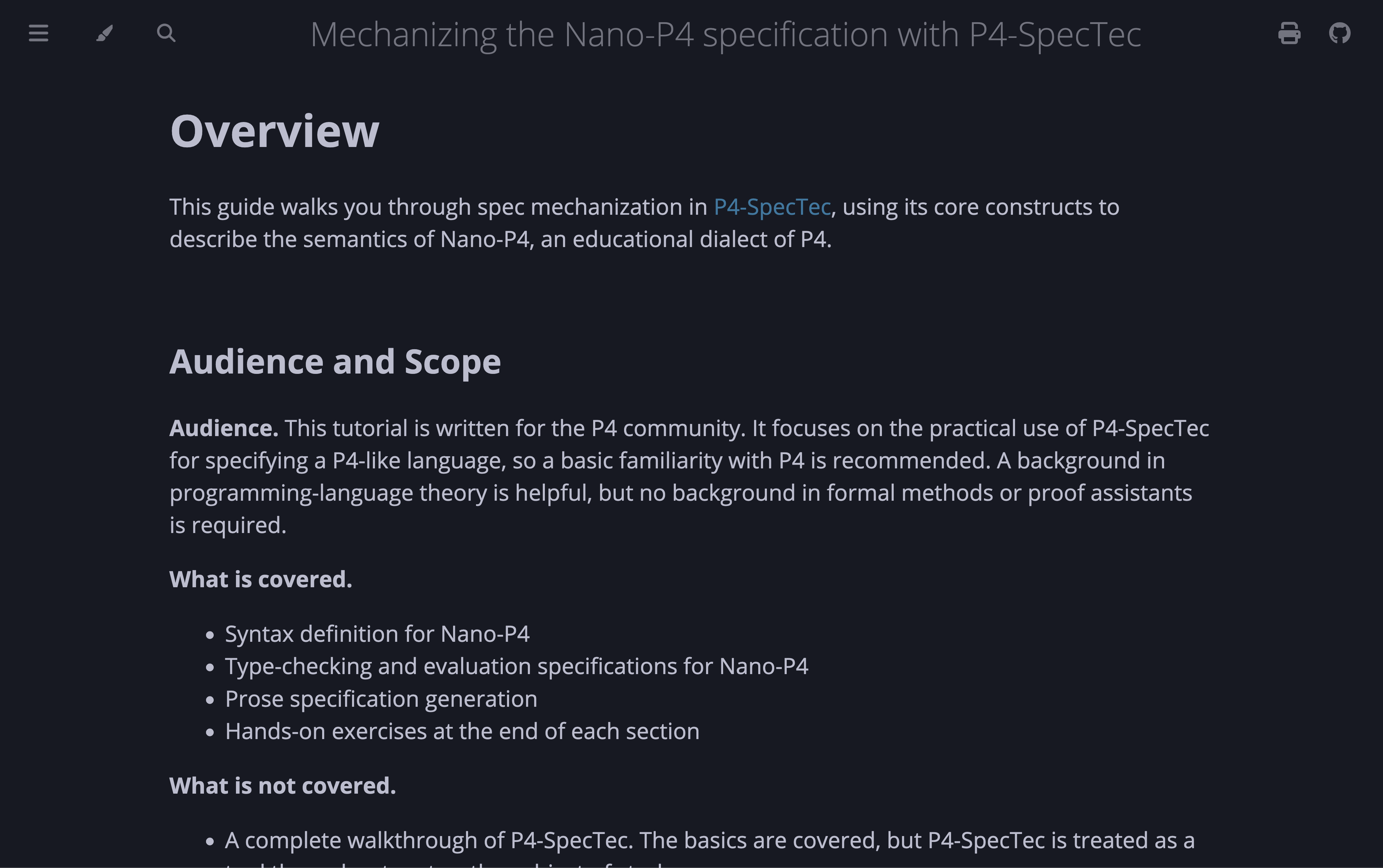
The deployed book is live at: https://kaist-plrg.github.io/nano-p4-tutorial
 Tutorial overview page
Following the tutorial hands-on
To run nano-p4spectec against the specification as you read, install the
toolchain as described in
Chapter 1: Installation.
The p4-spectec
repository also
ships a Nix flake for a fully reproducible setup.
With all dependencies installed, build nano-p4spectec:
git clone https://github.com/kaist-plrg/p4-spectec
cd p4-spectec
git checkout gsoc-nano-spec
nix develop  # or: install dependencies manually
make release
Building the book locally
To build and serve the book locally, clone the tutorial repository and use its
Nix flake (which pins mdbook and cargo) or install them manually:
git clone https://github.com/kaist-plrg/nano-p4-tutorial
cd nano-p4-tutorial
nix develop  # or: install mdbook and cargo manually
make serve
Then open http://localhost:3000 in a browser.
Executing the specification
To type-check a Nano-P4 program:
./nano-p4spectec check nano-p4/spec -i nano-p4/include -p nano-p4/testdata/positive/free-pass.p4
A well-typed program prints pass. A type error prints a rule-trace tree
identifying the failing relation and source location.
$ ./nano-p4spectec check nano-p4/spec -i nano-p4/include -p nano-p4/testdata/positive/free-pass.p4
passed
To run the interpreter on a packet:
$ ./nano-p4spectec eval nano-p4/spec -i nano-p4/include -p nano-p4/testdata/positive/free-pass.p4 -stf nano-p4/testdata/positive/free-pass.stf
[PASS] Transmitted (0) 00
passed
Generating prose documentation
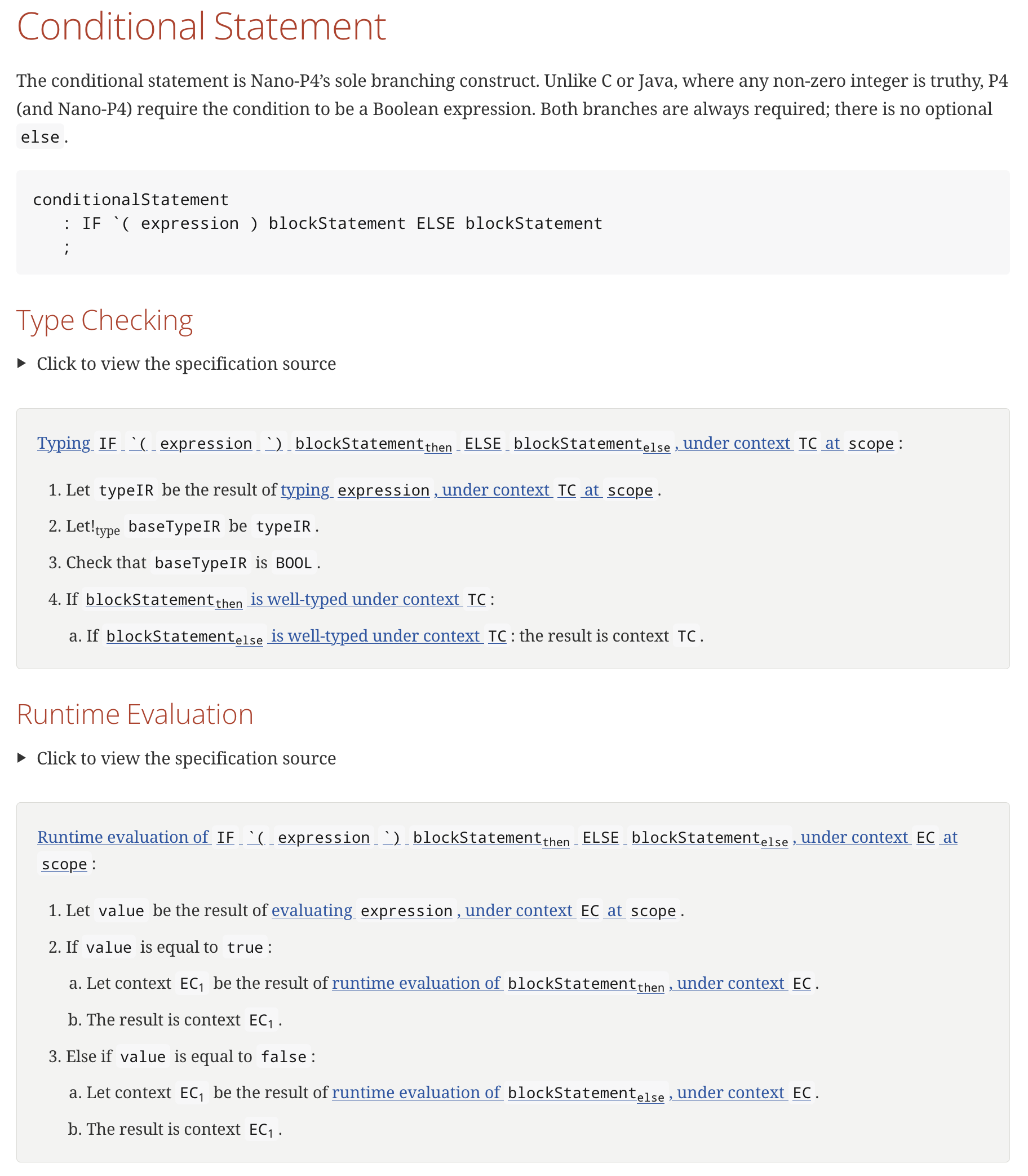
To generate prose from the conditional statement skeleton:
./nano-p4spectec splice nano-p4/spec \
  -splice nano-p4/docs/sections-skeleton/conditional-statement.adoc \
  -out out/conditional-statement.adoc
asciidoctor -o out/conditional-statement.html out/conditional-statement.adoc
 Rendered prose specification for the conditional statement
Results
- A complete mechanized specification for Nano-P4 in P4-SpecTec, covering syntax, static semantics, a loading phase, and dynamic semantics.
- A seven-chapter mdBook tutorial published at kaist-plrg.github.io/nano-p4-tutorial, covering P4-SpecTec basics, the full Nano-P4 mechanization, debugging techniques, and prose generation, with hands-on exercises throughout.
- Reproducible development environments for P4-SpecTec via a Nix flake (pinned
in the tutorial repository) and an opam package (distributed with
kaist-plrg/p4-spectec).
Future Work
P4-SpecTec language reference: The tutorial is designed to introduce P4-SpecTec constructs as they are needed to write the Nano-P4 spec, not as a systematic reference. A dedicated P4-SpecTec language reference document, one that covers all constructs, syntax forms, and built-in functions in a lookup-friendly format, would complement the tutorial well.
Open-ended exercises: The current exercises are closely guided: the reader is told what is missing and roughly where to look. A natural next step is open-ended exercises where the reader is given a feature description and must figure out the spec changes themselves. Adding a validity bit to header types is one good candidate: it touches the IR definitions, type checking, and evaluation, requires the reader to think about where validity is checked and how it propagates.