Abstract
P4 Traffic Control (P4TC) is a Linux kernel subsystem that
runs P4 programs in the networking data path - either in software via eBPF, or
offloaded to hardware like SmartNICs. Its userspace runtime API (libp4tctrl)
is a C library that requires manual memory management, pointer arithmetic, and
raw byte handling.
This project built complete, high-level API wrappers in Python and Rust that let developers manage P4 objects (tables, externs) and event subscriptions using native language idioms. Both wrappers handle object allocation/deallocation, callback bridging, response parsing, and schema-driven type decoding - exposing a clean, idiomatic API in each language.
Architecture
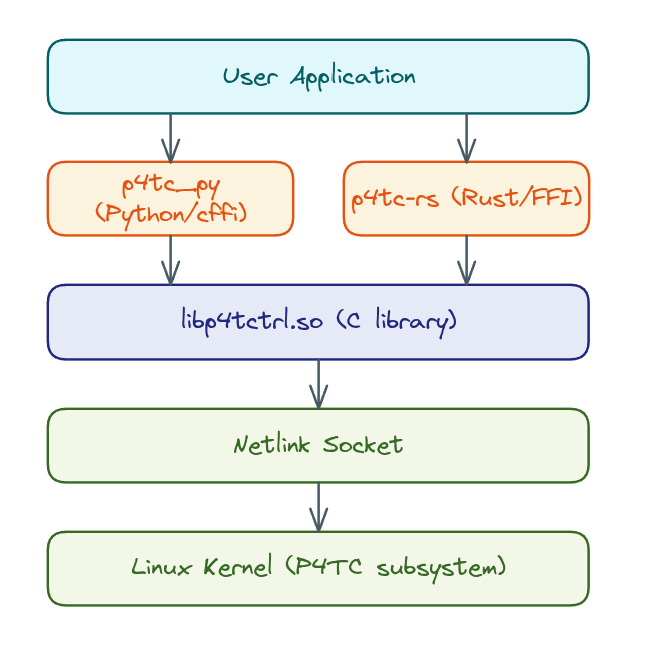
Both wrappers sit between user code and the C library (libp4tctrl). Python
uses cffi with dlopen for FFI; Rust uses bindgen with a sys crate. Each
wrapper translates high-level calls into the C API’s object lifecycle
(create, configure, execute, destroy) and parses kernel responses back into
native data types.
Repositories
| Repo | Language |
|---|---|
| p4tc-py | Python |
| p4tc-rs | Rust |
Both repositories are self-contained - each includes source, examples,
documentation, tests, and a bundled test pipeline (register.tgz).
Before / After
What used to take ~8 lines of C with manual object lifecycle management now takes 1-3 lines in Python or Rust:
C (before):
struct p4tc_obj *obj = p4tc_obj_create("register", P4TC_OBJ_TABLE);
p4tc_obj_objname_set(obj, "ingress/nh_table");
struct p4tc_key *key = p4tc_make_key(obj, 1, (const char*[]){"10.0.0.1"});
struct p4tc_runt_tbl_attrs *entry = p4tc_alloc_tbl_entry(obj, key, 0, 0);
p4tc_create_runt_act(entry, "ingress/send_nh", 3,
    (const char*[]){"eth0", "00:aa:bb:cc:dd:ee", "00:11:22:33:44:55"});
p4tc_create(ctx, obj, 0, NULL, NULL);
p4tc_obj_destroy(obj);
Python (after):
ctx.create("register", "ingress/nh_table",
           key=["10.0.0.1"],
           action=("ingress/send_nh", ["eth0", "00:aa:bb:cc:dd:ee", "00:11:22:33:44:55"]))
Rust (after):
ctx.create("register", "ingress/nh_table")
    .key("10.0.0.1")
    .action("ingress/send_nh")
    .params(&["eth0", "00:aa:bb:cc:dd:ee", "00:11:22:33:44:55"])
    .execute()?;
The API is identical in both languages by design - if you know one, you know the other.
Features
Both wrappers provide identical functionality:
| Feature | Description |
|---|---|
| Pipeline Provisioning | Load a P4 pipeline from the kernel’s template system. Parses the compiler-generated JSON schema for type information. |
| Context Management | Create netlink transport contexts for kernel communication. Python supports with statements; Rust uses Drop. |
| Object CRUD | create, get, update, delete, dump, flush - full lifecycle management of P4 runtime objects. |
| Extern Operations | extern_update and extern_get for P4 externs (e.g., Registers). |
| Event Subscriptions | subscribe to receive real-time notifications on P4 object changes via background callbacks. |
| Schema-Driven Decoding | Automatically decode raw kernel bytes into typed values (IPv4, IPv6, MAC, integers) using the P4 compiler’s JSON schema. |
| Error Handling | Structured error hierarchy with errno propagation from the kernel. |
Schema-Driven Type Decoding
One of the most impactful features. Without it, callbacks receive raw binary:
key: {'raw': b'\x0a\x00\x00\x01'}
param: b'\x00\xaa\xbb\xcc\xdd\xee'
With schema decoding enabled:
key: {'dstAddr': '10.0.0.1'}
param: srcMac = '00:aa:bb:cc:dd:ee'
The schema parser reads the P4 compiler’s JSON output and maps field names,
types, and byte offsets to automatically convert key bytes and action parameters
in all callbacks (get, dump, subscribe).
Event Subscriptions
# Python
def on_event(entries, phase):
    for entry in entries:
        print(f"  event: phase={phase.name}, table={entry.table_name}, "
              f"key={entry.key}")

sub = ctx.subscribe("register", "ingress/nh_table", callback=on_event)
sub.start()
# ... CRUD on same context triggers callbacks ...
sub.stop()
// Rust
let mut sub = ctx.subscribe(PIPE, TABLE, move |entries, phase| {
    for entry in entries {
        println!("  event: phase={:?}, table={}, key={:?}",
                 phase, entry.table_name(), entry.key());
    }
}).expect("subscribe failed");
// ... CRUD on same context triggers callbacks ...
sub.stop();
Upstream Contributions
Work on the wrappers drove improvements to libp4tctrl itself, coordinated
with my mentors:
| Issue | Resolution |
|---|---|
C11 _Generic macros made FFI impossible | Upstream replaced macros with typed function variants |
No programmatic getters (only p4tc_obj_dump to stdout) | Upstream added 30+ accessor functions |
| Extern API required dummy params for get operations | Upstream changed to accept n_params=0, params=NULL |
| Subscribe socket contention with CRUD on shared context | Upstream fix 43a46dcf1bb0 |
All upstream changes are in the p4tc-tutorial repository, branch gsoc_2026.
Challenges
FFI Closure Bridging - The C library’s strict 8-byte cookie alignment silently skipped Rust callbacks at unaligned stack addresses. Python uses
ffi.NULLfor cookie; Rust uses aBox<u64>cookie pointing to a heap-allocated closure.C11
_GenericMacros - Neither cffi nor bindgen can handle compile-time type dispatch. Required an upstream API change before FFI binding was possible.Missing Programmatic Getters - 30+ getter functions had to be added upstream to enable proper response types (
TableEntry,Action,Param,ExternEntry).Subscription Architecture (3 iterations) - Went from a blocking loop, to separate contexts, to a single-context design after the mentor’s upstream fix revealed that
p4tc_subscribe_resp_handlespawns an internal thread.Type Decoding from Raw Bytes - Mapping raw
void*buffers to typed values using the P4 compiler’s JSON schema. Getting byte order, padding, and bitfield extraction right across IPv4, IPv6, MAC addresses, and variable-width integers was the trickiest implementation challenge.
Future Work
I plan to continue maintaining both wrappers after GSoC. Planned improvements:
- New API coverage - support new
libp4tctrlfeatures as they are added - CI/CD - automated testing against the P4TC VM
- Upstream bug fixes - follow up on reported issues and integrate fixes
References
- P4 Traffic Control (P4TC) — https://p4tc.dev/
- P4 language consortium — https://p4.org/
- P4TC: P4 Traffic Control — EuroP4 2023 paper — https://dl.acm.org/doi/10.1145/3630047.3630193
- P4TC kernel datapath — https://github.com/p4tc-dev/linux-p4tc-pub
- P4TC iproute2 — https://github.com/p4tc-dev/iproute2-p4tc-pub
- P4TC tutorial — https://github.com/p4tc-dev/p4tc-tutorial-pub
- P4TC examples — https://github.com/p4tc-dev/p4tc-examples-pub
- Full GSoC final report — https://gist.github.com/atta-ullah01/86b98954265817c62e27bccae89d5fd6